
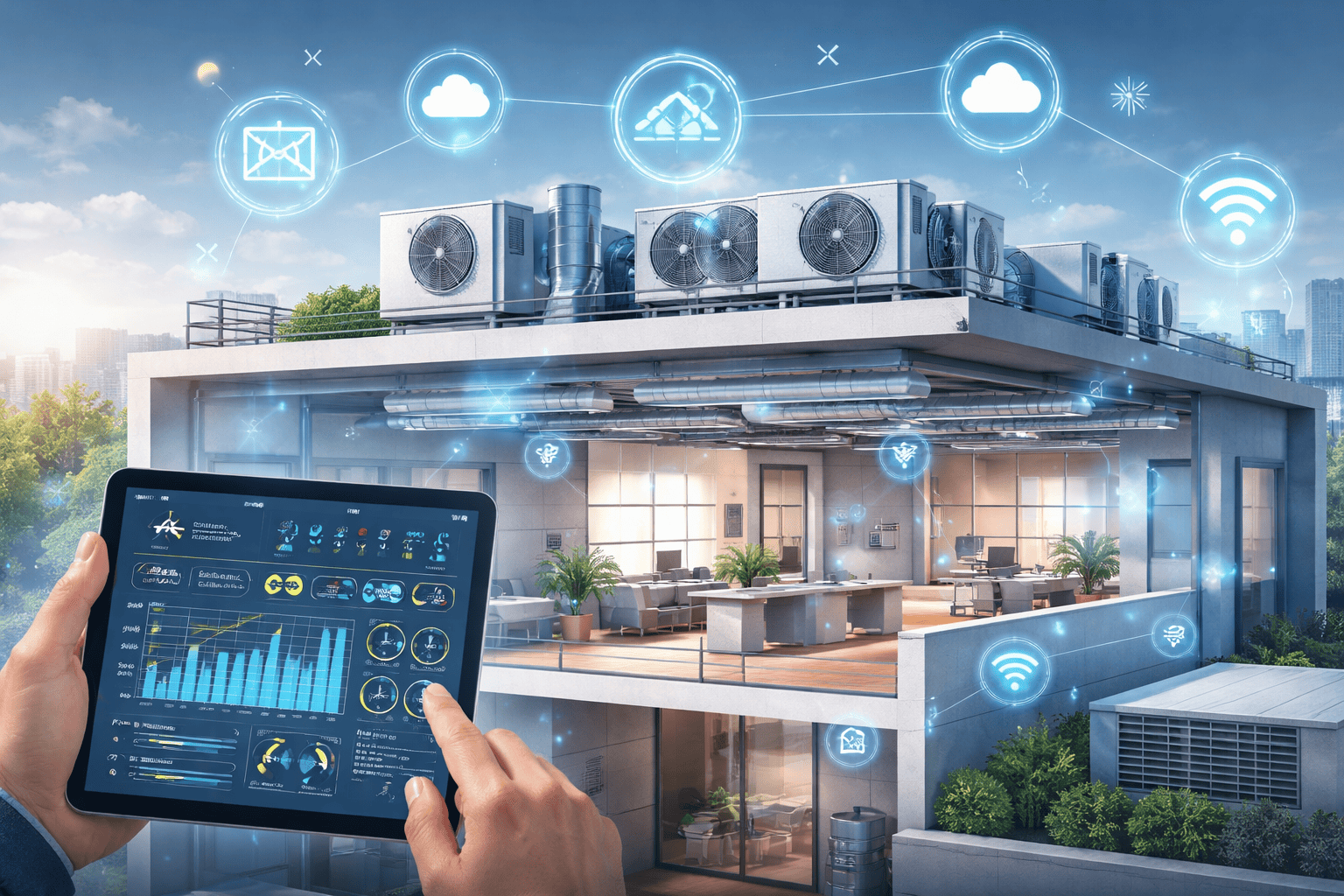
Heating, ventilation, and air conditioning systems (HVAC) are responsible for a large portion of the energy consumed in residential and commercial buildings nowadays. Despite the fact that most buildings, even now, rely on control methods such as Rule Based Control (RBC), which operate based on predefined logical conditions, or Proportional-Integral-Derivative (PID), alternative more advanced control strategies have emerged, like Model Predictive Control (MPC) and Differentiable Predictive Control (DPC), in order to reduce the use of HVAC energy while at the same maintain thermal comfort. MPC is a model based control strategy, where a constrained optimization problem is solved in order for the optimal control actions to be determined over a future horizon. In the receding horizon approach, only the first control input is applied, then the horizon shifts forward, and the optimization problem is solved again in the next timestep.
The primary objective of a MPC strategy is to minimize a cost function comprising of different terms relating to:
- Thermal Comfort: penalizing deviations from a desired temperature setpoint,
- Energy Cost: minimize the energy cost associated with energy consumption,
- Control Effort: promote smooth control actions.
This minimization is performed subject to a number of constraints such as:
- Dynamic constraints: describing how the indoor temperature evolves over time, given as
equality constraints, - Operational constraints: describing the limitations of HVAC equipment, such as minimum and maximum values of temperature setpoints and acceptable ranges for indoor temperature, given as inequality constraints.
The ability to predict how a building’s indoor temperature will evolve over an horizon allows the MPC controller for example to preheat the building in anticipation of an upcoming increased electricity price outperforming conventional controllers. A critical component of MPC, is the model used for predictions, which can either be classified as white-box, based on principles of heat transfer, gray-box, which are reduced order models, and finally black-box which are purely data driven models. In spite of the type chosen, it is critical that the model is reliable since any significant mismatch between the model’s prediction and the actual system behavior can degrade the controller’s performance.
With recent progress in AI and differentiable programming, new control paradigms have emerged, such as DPC. In DPC, a neural network is trained offline to learn an explicit control policy by minimizing an MPC objective through a differentiable model of the building dynamics and the resulting closed-loop evolution. Initially, a model is identified from measured trajectories, and then a neural control law is learned by minimizing an MPC loss subject to the closed-loop dynamics, with constraints typically handled via penalties or barrier-like terms. At runtime, control reduces to a forward pass through the trained network, which can be substantially less computationally demanding than solving an online MPC optimization problem and may therefore be suitable for real-time embedded deployment. However, unlike online MPC, strict guarantees of feasibility and optimality are generally not ensured for the learned policy.
The control paradigms described above are directly aligned with DOMX’s role and technical contribution within the AI-DAPT project, where the focus is on AI pipelines for training and deploying deep learning models. DOMX brings practical expertise in large-scale IoT eployments, building telemetry, and AI-based energy optimization and is working on integrating the aforementioned control strategies within their energy-efficient solutions, contributing to measurable reductions in HVAC energy consumption while maintaining occupant thermal comfort.
The interested reader is referred to [DAF+20] for an overview of MPC for buildings and to [DTS+21] for DPC.
References
[DAF+20] Jan Drgona, Javier Arroyo, Iago Cupeiro Figueroa, David Blum, Krzysztof Arendt, Donghun Kim, Enric Perarnau Olle, Juraj Oravec, Michael Wetter, Draguna L Vrabie, et al. All you need to know about model predictive control for buildings. Annual reviews in control, 50:190–232, 2020.
[DTS+21] Jan Drgona, Aaron Tuor, Elliott Skomski, Soumya Vasisht, and Draguna Vrabie. Deep learning explicit differentiable predictive control laws for buildings. IFAC-PapersOnLine, 54(6):14–19, 2021.


